FiiO K11 R2R Zwart


Specificaties en functies


FiiO K11 R2R, desktop DAC and headphone amplifier
Resistor ladder DACs had almost disappeared from audio catalogues when delta-sigma chips took over the market: too expensive to produce, too delicate to calibrate. FiiO chose to develop its own rather than buy a ready-made chip, and to house it in the compact K11 enclosure. The result retains the connectivity and format of the latter, with an entirely different conversion stage.
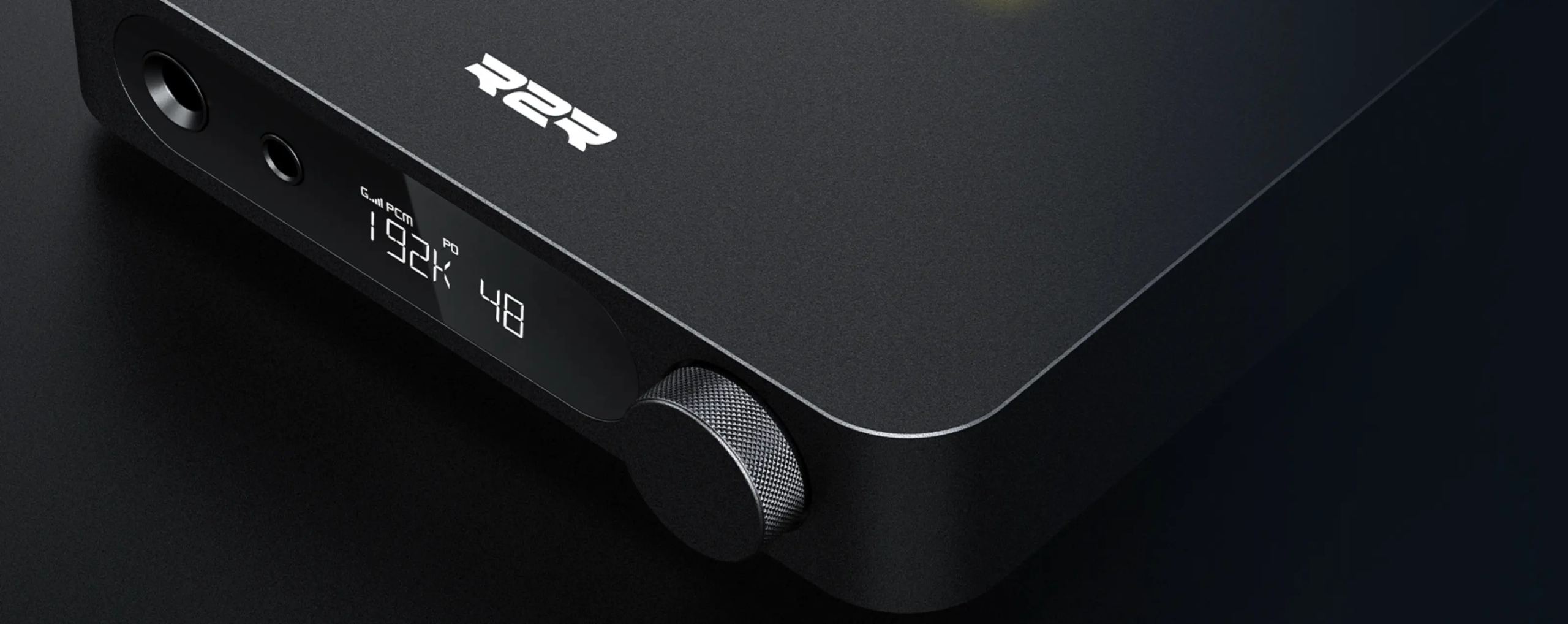
An in-house DAC with 192 resistors
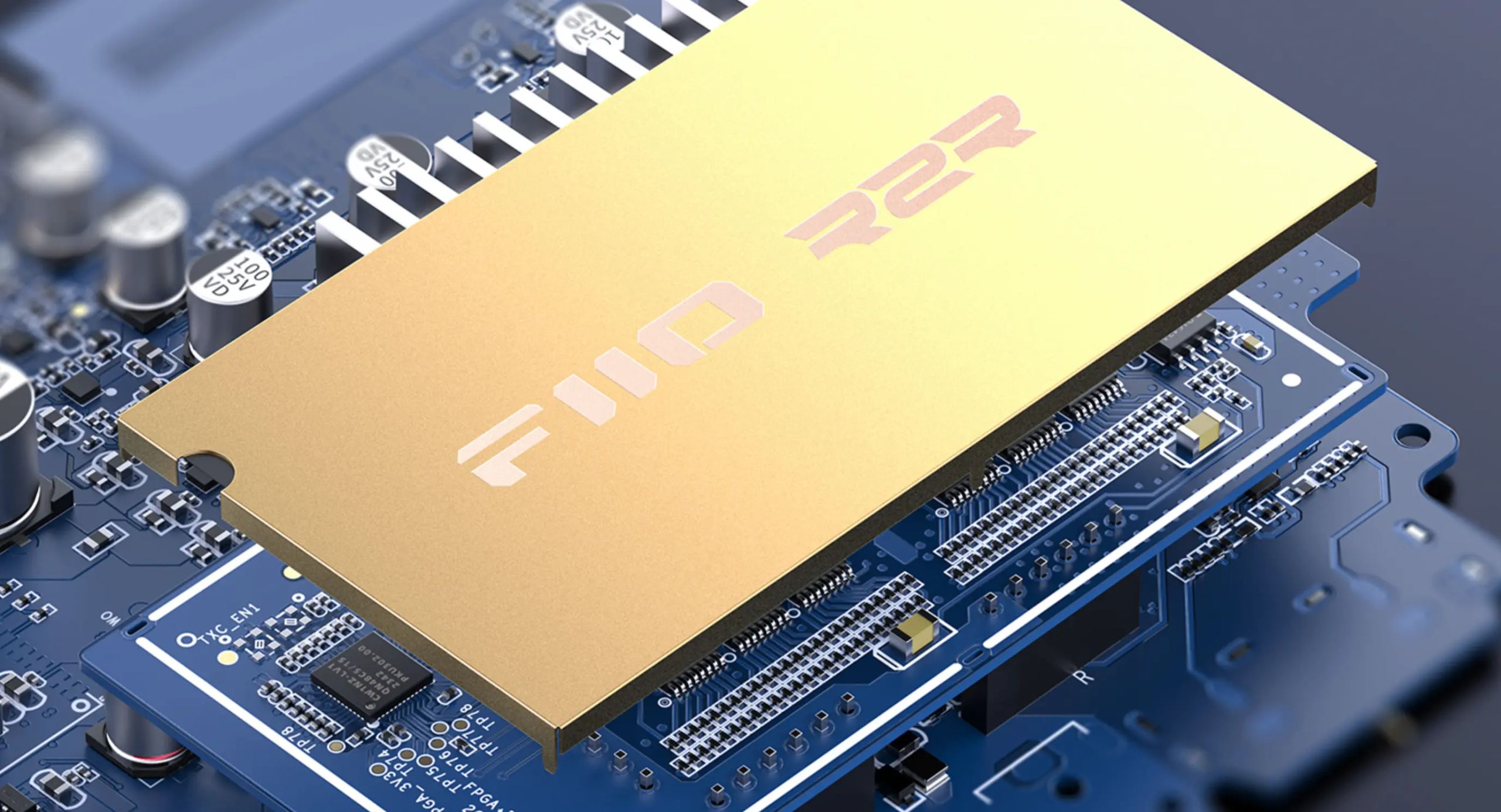
The R2R principle can be summed up in one sentence: each bit of the digital signal switches a resistor network that directly produces an analogue voltage, without high-frequency modulation or noise shaping. FiiO selected a so-called sign-magnitude conversion, with two networks of 48 thin-film resistors per channel, i.e. 96 per channel and 192 in total, matched to 0.1% and specified with a thermal drift of 30 ppm. The assembly operates in fully differential mode over four paths, lowering the noise floor compared with an unbalanced design.
The signal path runs through an SA9312L USB receiver, an audio bridge and then an FPGA that feeds the resistor networks. At the conversion output, two Texas Instruments OPA1642 op-amps provide low-pass filtering and conversion back to unbalanced operation, volume is managed by an NJW1195A electronic controller, and the output stage is based on two SGM8262 modules. The power supply uses 17 low-noise LDO regulators and two DC-DC converters separating analogue and digital circuits; the metal chassis incorporates phosphor bronze shielding and an aluminium heatsink.
The precision of an R2R DAC depends entirely on resistor matching, whereas a delta-sigma chip pushes noise outside the audible band through computation. The measurements published by FiiO reflect this: 0.025% distortion, 115 dB signal-to-noise ratio, 107 dB dynamic range. Solid figures, without matching those of a massive oversampling stage. The brand embraces this positioning and describes its R2R as smoother in the bass and fuller on vocals than the delta-sigma-chip K11, with the latter retaining the advantage in pure resolution.
NOS or oversampling, two processing options
OS mode raises all streams to 384 kHz before conversion. NOS mode decodes at the original rate, without an interpolation filter: the response rolls off slightly in the extreme treble and alias images above the audio band are no longer suppressed, producing a rendition that some find more direct with 44.1 kHz recordings. The difference between the two modes remains subtle, and the choice is a matter of taste rather than performance.
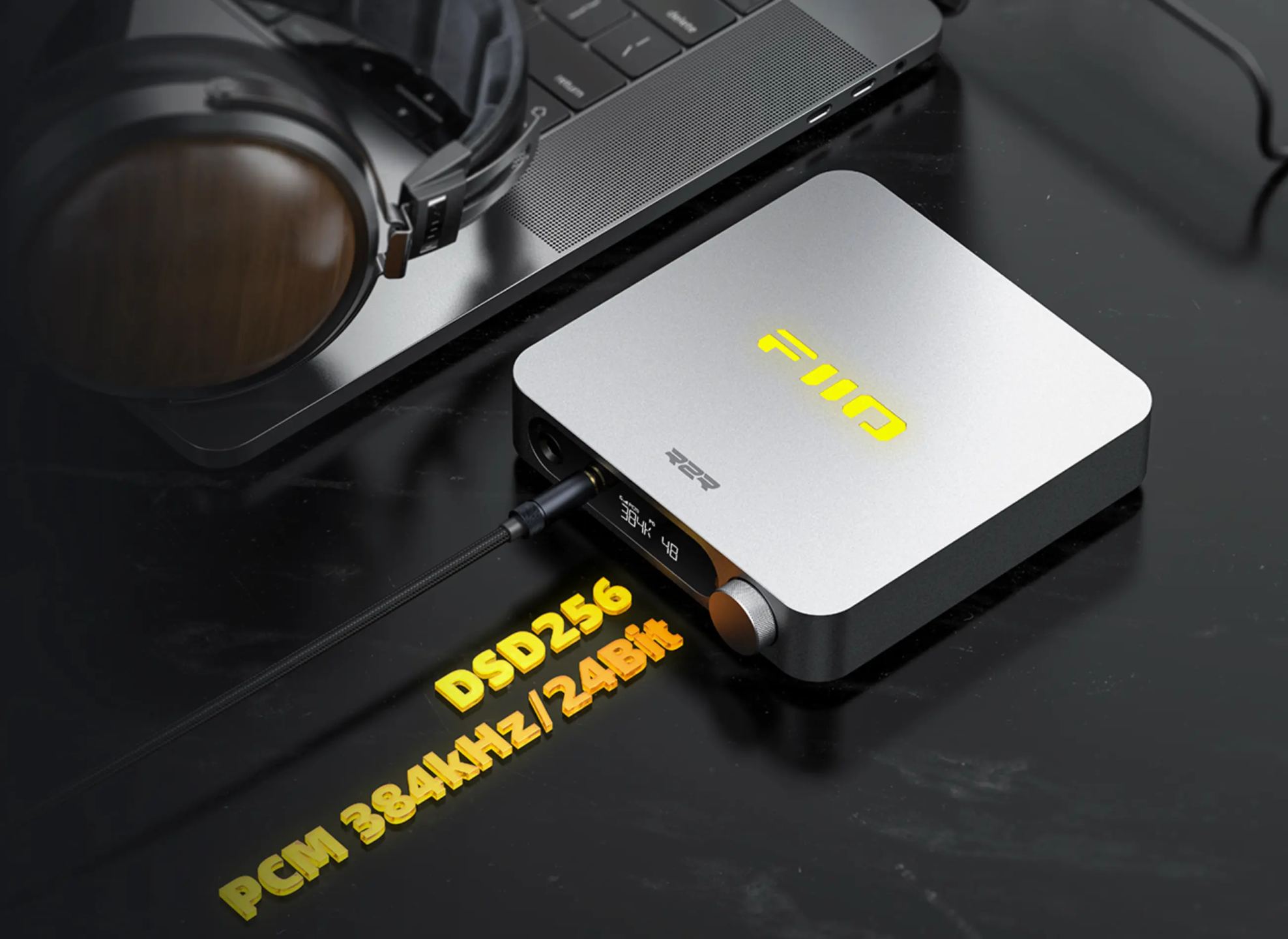
This switch replaces the K11’s selection of digital filters, unavailable here because R2R conversion does not operate in the same way. PCM is accepted up to 384 kHz at 32 bits via USB and DSD256 is supported, with one caveat to bear in mind: the DSD stream is internally converted to PCM before reaching the resistor networks, and the source must be set to native DSD output for recognition to occur.
1,300 mW at 32 ohms balanced
Headphone amplification follows the same differential structure. The 4.4 mm jack delivers 1,300 mW per channel at 32 ohms, 520 mW at 16 ohms and 220 mW at 300 ohms; the 6.35 mm jack delivers 460, 660 and 50 mW respectively. FiiO specifies an impedance range of 8 to 350 ohms in balanced mode and 8 to 150 ohms in unbalanced mode, with three gain levels and three associated volume curves.
These differences have practical consequences. A 300-ohm dynamic headphone will find considerably more headroom on the balanced output, whose channel separation reaches 107 dB versus 72 dB in unbalanced mode. For highly sensitive in-ear monitors, the logic is reversed: the measured noise floor is 14.1 µV in balanced mode versus 7.2 µV in unbalanced mode, and output impedance is 1.5 ohms versus less than 1 ohm. The 6.35 mm jack at low gain remains the best starting point with low-impedance hoofdtelefoons. A headphone protection circuit and a switching-noise suppression device complete the output stage.
The RCA output makes it a preamplifier
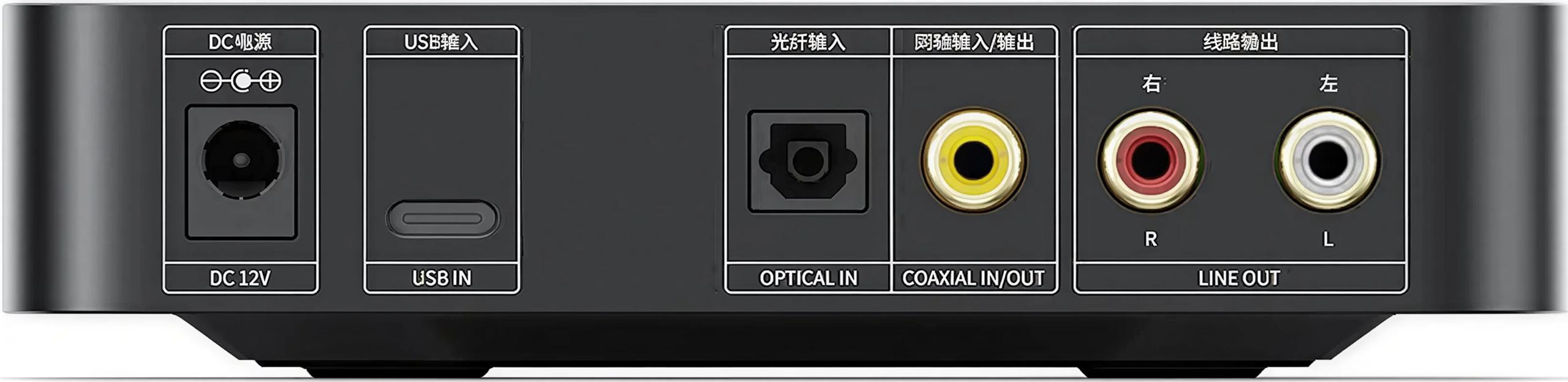
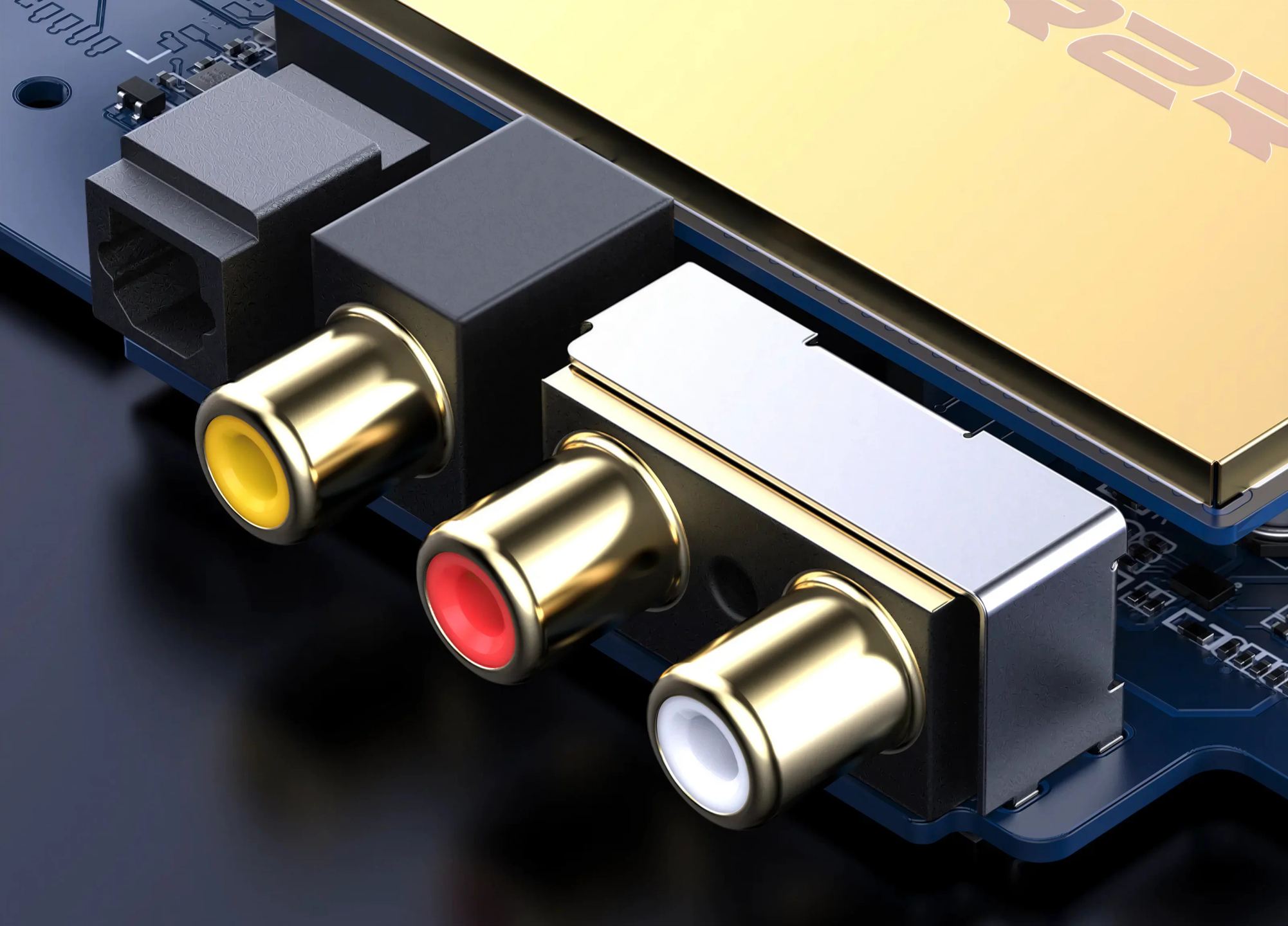
At the rear, the RCA line output delivers 2.7 Vrms and operates at fixed level or variable level controlled by the knob. In the first case, the device serves as a DAC for an geïntegreerde versterker; in the second, it directly drives actieve luidsprekers or a power amplifier, without an intermediate voorversterker. This dual function explains much of its versatility on a desk where headphones and speakers coexist.
Digital inputs include USB-C, optical Toslink and coaxial, with different maximum resolutions: 384 kHz at 32 bits via USB, 192 kHz at 24 bits via coaxial, 96 kHz at 24 bits via optical. The coaxial connector serves as both input and output, and the output function is active only in USB mode, allowing a stream to be sent from a computer to another DAC.
Control is centred around a single knob
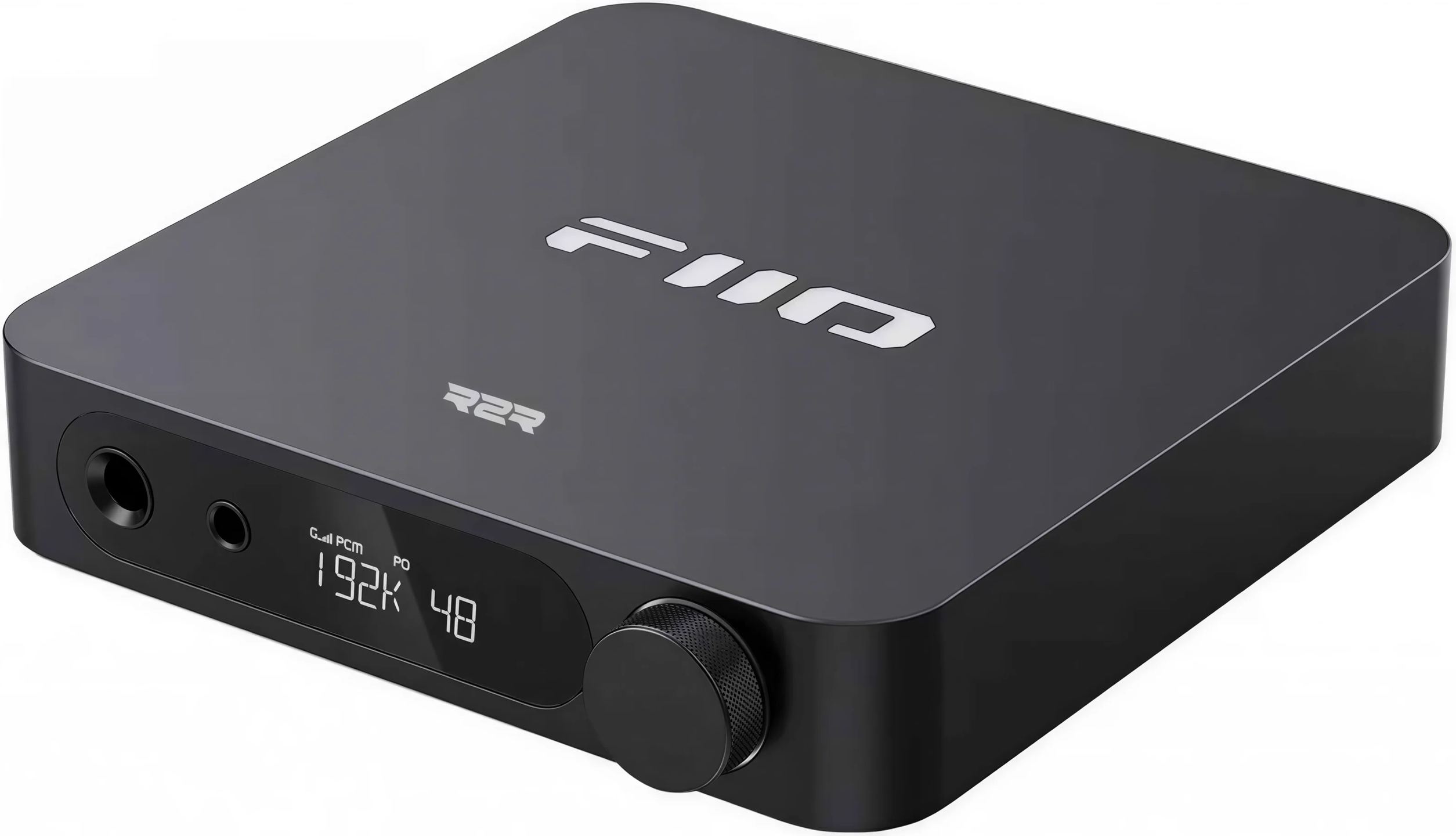
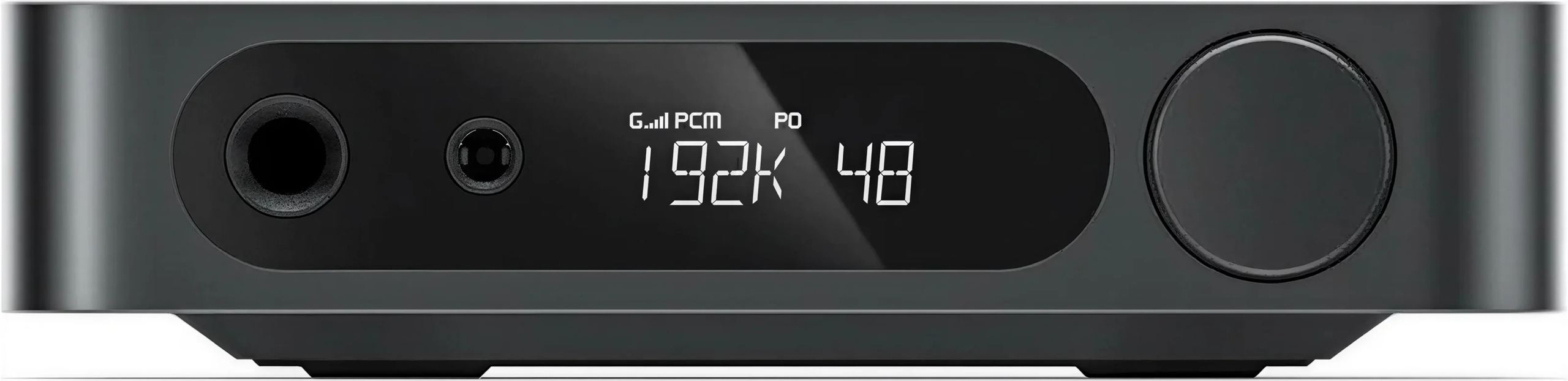
The unit is operated with a rotary encoder and a small monochrome LCD screen displaying volume, gain, the active output and the current sampling frequency. The backlit logo on the top panel changes appearance according to the type of stream received—standard resolution, high resolution or DSD—providing an immediate indication of what the source is actually sending. Automatic standby has been added compared with the K11.
The enclosure measures 147 × 133 × 32.3 mm including feet and weighs 420 g, a format close to that of a CD case that fits beneath a computer monitor. Power is supplied by an external 12 V / 2 A adapter, and firmware updates are performed via the USB port.
Technische kenmerken
Sterke punten
- 24-bits passieve R2R-DAC ontwikkeld door FiiO
- Hi-Res Audio-weergave tot 32 bits / 384 kHz en DSD256
- Hoog vermogen tot 1300 mW per kanaal
- Gebalanceerde 4,4 mm- en ongebalanceerde 6,35 mm-hoofdtelefoonuitgangen
- Compatibel met hoofdtelefoons van 8 tot 350 Ω
- USB-DAC-, hoofdtelefoonversterker- en voorversterkerfunctie
Digitaal-analoogomzetter
- R2R-DAC met hoge precisie
- Volledig differentiële architectuur
- Passieve R2R-conversie met 192 precisieweerstanden
- 96 weerstanden per kanaal
- Tolerantie: ±0,1 %
- Twee conversiemodi:
- NOS (zonder oversampling)
- OS (oversampling tot 384 kHz)
- Compatibele formaten:
- PCM tot 24 bits / 384 kHz
- DSD256
- Hi-Res Audio
Hoofdtelefoonversterking
- Volledig differentiële gebalanceerde architectuur
- Compatibel met hoofdtelefoons van 8 tot 350 Ω
- Drie versterkingsniveaus: laag, gemiddeld, hoog
- Uitgangsvermogen:
- Gebalanceerde 4,4 mm-uitgang: tot 1300 mW per kanaal bij 32 Ω
- Ongebalanceerde 6,35 mm-uitgang: tot 460 mW per kanaal bij 32 Ω
Voorversterkerfunctie
- RCA-analoge uitgang
- Bedrijfsmodi:
- Vast niveau
- Variabel niveau met volumeregeling via draaiknop
Geïntegreerde technologieën
- Texas Instruments OPA1642-operationele versterkers
- SG Micro SGM8262-versterkermodules
- NJW1195A digitale volumeregeling
- Bescherming tegen gelijkstroom (DC)
- Vermindering van schakelruis (Pop)
Componenten en ontwerp
- Volledig differentiële dual-monoarchitectuur
- 17 precisie-LDO-regelaars
- Beryllium-solid-condensatoren
- Interne afscherming van fosforbrons
- Aluminium koellichaam
Aansluitingen
- Digitale ingangen:
- 1 × USB-C digitale audio
- 1 × TosLink optisch
- 1 × coaxiaal
- Uitgangen:
- 1 × 6,35 mm-jackhoofdtelefoon
- 1 × 4,4 mm gebalanceerde hoofdtelefoon
- 1 × XLR-4-hoofdtelefoon
- 1 × RCA-analoge uitgang
- 1 × coaxiale digitale uitgang
Gebruikersinterface
- Multifunctionele draaiknop
- LCD-monochroomscherm met hoge zichtbaarheid
- Weergegeven informatie: volume, versterkingsniveau, uitgangsmodus, bemonsteringsfrequentie
- RGB-logo dat het type audiostream aangeeft
Audioprestaties
- Gebalanceerde 4,4 mm-uitgang:
- Vermogen: 1300 mW bij 32 Ω
- Vervorming: 0,025 %
- Signaal-ruisverhouding: 115 dB
- Frequentierespons: 20 Hz – 50 kHz
- Kanaalscheiding: 107 dB
- Ongebalanceerde 6,35 mm-uitgang:
- Vermogen: 460 mW bij 32 Ω
- Vervorming: 0,025 %
- Signaal-ruisverhouding: 115 dB
- Frequentierespons: 20 Hz – 50 kHz
- Kanaalscheiding: 72 dB
Algemene informatie
- Type: USB-DAC, hoofdtelefoonversterker en voorversterker
- Afmetingen (B × H × D): 147 × 32 × 133 mm
- Gewicht: 420 g
Veelgestelde vragen
Kan de K11 R2R via een app worden ingesteld?
Nee. FiiO ondersteunt de FiiO Control-app niet op dit model: alle instellingen, gain, oversamplingmodus en het gedrag van de RCA-uitgang worden ingesteld via de draaiknop en het scherm. Firmware-updates verlopen via de USB-poort vanaf een computer.
Kan het worden gebruikt met een smartphone of spelconsole?
Ja. Het apparaat beschikt over een driverloze USB Audio Class 1.0-modus, die wordt herkend door consoles zoals de PS5 of Switch, en kan met een USB-C-naar-USB-C-kabel op een smartphone worden aangesloten. Onder Windows wordt aanbevolen de FiiO-driver te installeren om de hoogste resoluties te benutten.
Is er een speciale voeding nodig?
De meegeleverde netadapter levert 12 V en 2 A. Het apparaat bevat geen batterij en werkt, in tegenstelling tot een draagbare converter, niet uitsluitend op de voeding van de USB-poort: er moet dus een stopcontact in de buurt van het bureau beschikbaar zijn.
Wat is het verschil met de standaard K11?
Het chassis, de aansluitingen en het uitgangsvermogen zijn identiek. De K11 gebruikt een delta-sigma CS43198-chip en biedt keuze uit digitale filters; de K11 R2R vervangt deze chip door het eigen weerstandsnetwerk, laat de filters achterwege en krijgt NOS/OS-modi evenals automatische stand-by. De metingen van vervorming en ruis van beide modellen liggen dicht bij elkaar, het verschil zit in de weergave.
Is het geschikt voor zeer gevoelige in-ear-oordopjes?
Met enkele voorzorgsmaatregelen. De lage gain en de asymmetrische 6,35 mm-uitgang, waarvan de ruisvloer het laagst is van de twee, geven de beste resultaten; een adapter van 6,35 naar 3,5 mm wordt meegeleverd. De gevoeligste modellen kunnen een lichte ruis hoorbaar maken op de symmetrische uitgang, waarvan het nut vooral merkbaar is met hoofdtelefoons die veel spanning vereisen.
Wat gebeurt er als de bron 32-bits uitstuurt?
De USB-interface accepteert streams tot 384 kHz in 32 bit, maar de weerstandsnetwerken voeren een conversie uit op 24 bit. De extra bits leveren niets hoorbaars op: het werkelijke dynamische bereik van een converter blijft ruimschoots onder de theoretische 144 dB van 24 bit.
- Ecobijdrage van € 0,12 inbegrepen in de verkoopprijs.
- Fabrikantreferentie: FIIK11R2RNR
- GTIN / EAN: 6953175710721